
When a Belper business began renovating one of the town’s most historic buildings as its new base, it sparked renewed interest in the area’s past.
Claire’s School Solutions is a supply teaching agency and will soon move into The Old School House on Green Lane – the second oldest building in Belper.
The company asked local historian Adrian Farmer to advise on the building’s history. It prompted a wider curiosity, culminating in a neighbourhood walk with Adrian which gave intriguing glimpses into the past.
Jo Gotheridge, who works as social media assistant for Claire’s School Solutions, shares their guided tour.
The Missing Bridge
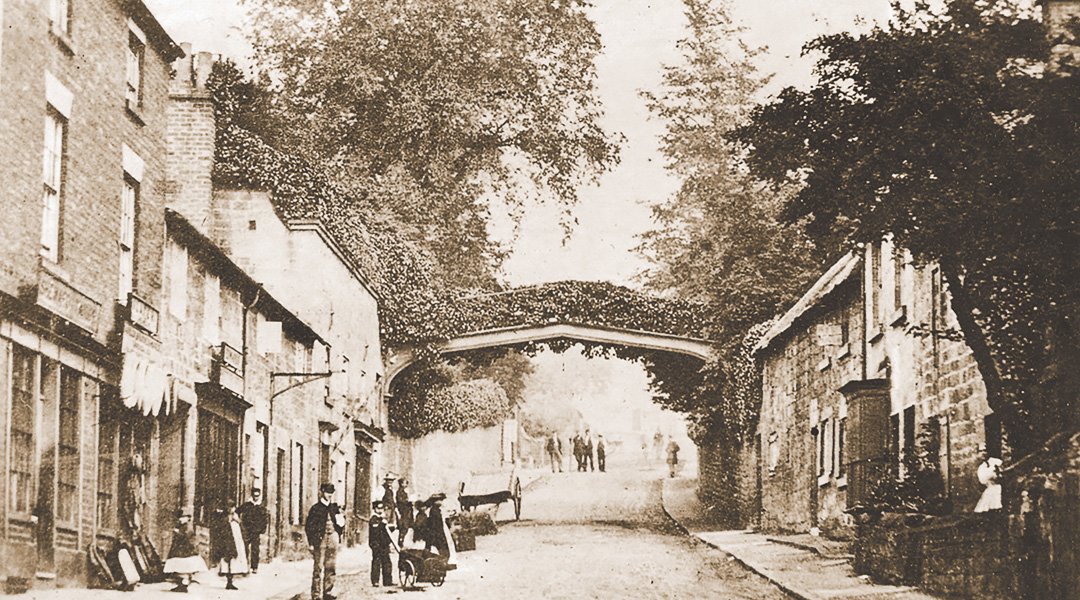
We started our guided walk at the Memorial Gardens looking down King Street – such a familiar sight to the residents of Belper! What is less familiar is the fact that there was once an ornate bridge across the road from what was the Strutts’ manor house to the memorial garden opposite.
The reason for this bridge was purely so that Jedediah Strutt’s staff could take food for parties in the garden via the bridge rather than using the road which the general public used. How extravagant! Especially when you consider that the bridge was only there from 1832-1867.
After the Strutts relocated, their previous home (minus the bridge), known as Green Hall, was used as a hospital during the First World War.
Green Lane
We walked to Green Lane – the location of our new premises. We were surprised to learn that this lane was previously called ‘Market Street Lane’ and before that ‘Meeting House Lane’. This makes sense as we have also been informed that our new building was also once called The Old Meeting House.
We are passionate about keeping the spirit of the school house and being sensitive to the aesthetic appearance of what is the second oldest building in Belper. We view it as a real privilege to be restoring this building, using local suppliers and craftsmen in order to support the local community.
Up, up and Away!
As we proceeded along the road towards Albert Street, we learned that, in the 1880s, this area was known as ‘Festival Field. We were stunned to learn that this was the scene of what should have been the town’s first manned balloon flight.
However, it didn’t take off as planned – the reason given was ‘bad air’! Once the man had come out of the basket, the balloon shot into the air and flew over towards the Chevin, pursued by the owner who borrowed a horse to chase after it! It is definitely the stuff that would make the local news these days!
Other buildings of note on Green Lane
As we looked at Beech Lawn, now a solicitors, we learned that this was a doctor’s home, with a surgery down the side which operated until the 1960s. Sadly the big Beech tree has since been removed but the name remains.
The area near Green Lane was the religious sector of Belper, with the Congregational Church, St Peter’s Church and The Unitarian Chapel. There was once a Primitive Methodist chapel opposite St Peter’s called the Salem Chapel.
Old Town and New Town
As you look up the road, The Orchard, you can see a beautiful house, which was once a school for girls. The rest of the road, which leads up to the house, was previously a gated driveway up to the school.
As we proceeded along Green Lane, we learned that Field Lane was the boundary between the old and the new town, with Strutt workers’ houses to the north and the older pre-Strutt community to the south. The workers’ houses were tightly packed and located on Field Row, Joseph, William and George Street.
Cluster houses
On these parallel roads, cluster houses were built. The houses are designed to form four back-to-back houses. Each block was sited in the centre of a large plot and, as they were built, each house had a building in the garden incorporating a privy and a pigsty. It also meant that heating could be shared. These were among the more expensive Strutt properties, demanding a higher rent.
Field Row features houses of three storeys, a step up from the nearby houses in the Short Rows.
Home of the Nailers!
As we wandered down Joseph Street, we were able to see a unique, lasting reminder of the eminence of nail-making in the town. The Nailshop was just one of the buildings where up to 1000 nails were produced per day. There was high quality iron ore close to Belper.
At one point, there were 400 separate nailmakers in the town. Due to this significant workmanship in Belper at the time, can you guess now why the local football team is still to this day called ‘The Nailers’?! How many of those standing supporting on a Saturday actually know why this is?
You can see that the Nailshop stands almost exactly as it was, with the beautifully painted window and cast iron window frame.
Sinister times at The Cedars
As the night drew in and the air turned cold, Adrian took us down a sinister path where we learned that about the murder of Phoebe Barnes in the Cedars. On Friday, 26th March 1852, Anthony Turner was hanged for the murder of his employer, Mrs. Phoebe Barnes at Belper. She had written to him dismissing him from his post. Turner borrowed a large carving knife (used for cutting bacon) from a local shop, forced his way into her house, dragged her to the back yard and slit her throat.
Gitties, ginnels or alleyways? No – channels!
Cutting through the incredibly narrow paths – called channels – you can come to the other parallel roads of George Street and William Street. As we all had to breathe in, clearly the inhabitants who lived here before were built very differently!
Gas-lit beauty
Next – to Long Row, which is renowned for its beauty and breathtaking appearance. Even for someone who dropped her daughter off at the school here for many years, the sight of this once-gaslit street on this chilly night, was still a sight to behold. The stunning gas street lamps were restored in order to keep the unique appearance of this iconic street. Belper was only the second place out of London to have gas street lamps, installed in 1822. It came of no surprise to us to learn that when Adrian brought a contingent from UNESCO on a similar tour to us, one of the party was moved to tears by this street’s beauty.
Belper ice-cream
At the top of the road, stands the laundry house, which until 1992 was home to the ice cream factory Mazzas – a well-known family business.
What a pity that we do not still have an ice cream factory in the town, especially at the end of the road with a school.
Bring back Wakes week!
We were astonished to discover that there used to be ‘Wakes Week’ in the town in July. As part of this, there were wooden arches built over the road, decorated with garlands and flowers. The tradition of Wakes Week still happens in some Derbyshire villages, but sadly no more in Belper.
The return of the Donkey races
As we make our way back to Green Lane, a water pump on Short Row marks the start of the infamous donkey races, which will be re-enacted next year for the Strutt mills’ 250th anniversary celebrations, although sadly only with hobby horses! Although, perhaps it is best as when real donkeys were used, a brawl broke out when riders became overly-competitive and fought over who was to win the barrel of ale! I am sure next year’s celebrations will be far more dignified!
Steeped in history at our final stop
Our final stop was to be the Unitarian chapel, very appropriate as we are moving into the Unitarian School House at the other end of the lane. Jedediah Strutt built this – he was a committed Unitarian. Inside, it was as though we were stepping back in time; we could almost imagine Jedediah sitting in the pews. Although not these particular ones as these are tiny, specifically for the children of the Sunday school.
The culmination (and highlight of our tour) was when we were offered the opportunity to see the vault. Of course, we jumped at the chance – although with some trepidation on this dark night! However, this vault is not underground, as in many churches. Occasionally the vault is opened for tours and is candle lit.
The family crypt has open boxed spaces where the coffins would be placed and then sealed in. It was a sobering end to our visit.
The Claire’s team thoroughly enjoyed our historical tour of Green Lane and feel truly privileged to be a part of the ongoing restoration of the town. It is so important to embrace the history of our town, preserve it in keeping with the nature of what has passed before and look forward to many more years of being in Belper – this epicentre of Derwent Mills history.
Learn more about Claire’s School Solutions and its renovation project at https://www.weare-css.co.uk/our-new-offices/ or its Facebook page https://
www.facebook.com/profile.php? id=61572698997487