
Spurred on by wintry sunshine and undeterred by freezing temperatures, Marian Scaife shares her insights of the natural world in two traditional Peak District walks
Lathkill Dale in the White Peak
A robin eyes me woefully as I approach the mouth of Lathkill Head Cave. I sense its reluctance to fly. The inflated feathers create a ball-like appearance and the slow, hopeful foraging among the rocks suggests energy is precious and movement is costly.
An icy blast of Arctic air has greeted the start of 2026 and I’m walking east from Monyash through Ricklow Quarry and Lathkill Dale in the heart of the White Peak. A sprinkling of frozen snow grips the moss on the limestone rocks.
The south facing slopes benefit from the low sun. A kestrel hovers above the grassland, scanning for the urine trails of voles. The ground is still frozen, cutting off the invertebrate food supply to small mammals and some bird species. After a few minutes the kestrel gives up and flies north.
The reduced daylight, colder temperatures and scarcity of food mean wild animals must adapt to survive harsh winters. East of Ricklow Quarry I notice molehills. These subterranean mammals respond to a colder climate by digging deeper and decrease their energy needs by shrinking their brains!
The brain is a calorie demanding organ and for highly active mammals such as shrews, stoats and weasels, smaller brain and skull sizes are a cold temperature survival trade-off.
Lathkill Head Cave is one of the winter water sources of the River Lathkill. Today the mouth of the cave is dry. I take comfort when I see a grey wagtail strutting through the shallows of running water fed by natural ground water springs downstream.
Although life looks bleak for species subsisting along the bottom of the valley – the vascular plants and grasses droop with cold and dehydration – this is a stark contrast to life on the sunny side of the dale.
A raven flies out from limestone outcrop issuing a vocal protest to a family who have scrambled up the scree to sit in the sunshine and eat their lunch. Next month this species along with its corvid cousins will be nesting.
From the top of the south facing sun-filled slope, two Brown Hares chase each other out into the open to box, oblivious to the onlookers. This is January madness. I’m reluctant to judge the behaviour of wild animals but it seems unfair that the female must ward off the attention of a male suitor in such inhospitable conditions.
Within minutes of this spectacle, ominous grey and yellow clouds rumble across the sky and hefty snowflakes begin to land. At least the air temperature must be rising just a tad.
Dark Peak’s Big Moor and the Edges
It’s a day for big skies and horizons. I’m walking north along White Edge with views of Big Moor to the east and the farmland shoulders of the River Derwent to the west. It’s bright and sunny and the severity of the windchill means I can feel the cold penetrating my mouth through the side of my cheek. The path is daubed with patches of ice and frost.
Geologically speaking I’m on the east side of the horseshoe-shaped arc of millstone grit that dominates the Dark Peak and encapsulates most of White Peak. Etched in stone and buried in the acidic peat are relics and reminders that this was a working landscape in the Bronze Age.
The golds, dark mauves and greens of the moorland vegetation change continuously with the lowering sun. Out on the moor a herd of red deer graze, their red coats have been replaced with thick brown fur allowing Britain’s largest mammal to blend in surprisingly well with the habitat.
Occasionally a stag lifts his head displaying antlers which will be cast in spring, making way for the growth of a new pair to see him through the autumn rut. In winter, red deer relinquish their territorial disputes and opt for warmth in numbers, forming mixed herds of hinds, stags and juveniles. As the lush vegetation dies back over winter their diet becomes woodier and with less nutritional value leaving them to rely on fat reserves. Some stags may not have replenished these after the autumn rut; their survival is uncertain.
Descending from the moorland, I cross streams in the cloughs that lead to the Derwent. Sub-zero temperatures have caused the formation of icicles and globules of glazed ice along the edges of streams. Some of the shapes seem alien in the context of the natural environment they sit in.
Back out in the open I walk south on the top of Froggatt and Curbar Edge. The cold, clear conditions have rewarded me with far reaching views but encounters with wild animals have been limited. Right on cue, a male stonechat lands close by, flying from rock to rock. Described as a ‘restless’ bird by William Wordsworth this species is named after its call, part of which sounds like two stones being hit or ‘chacked’ together. Foraging stonechats like a low perch from which to scan the ground for invertebrates but, on a day like this, seeds and berries may have to do.
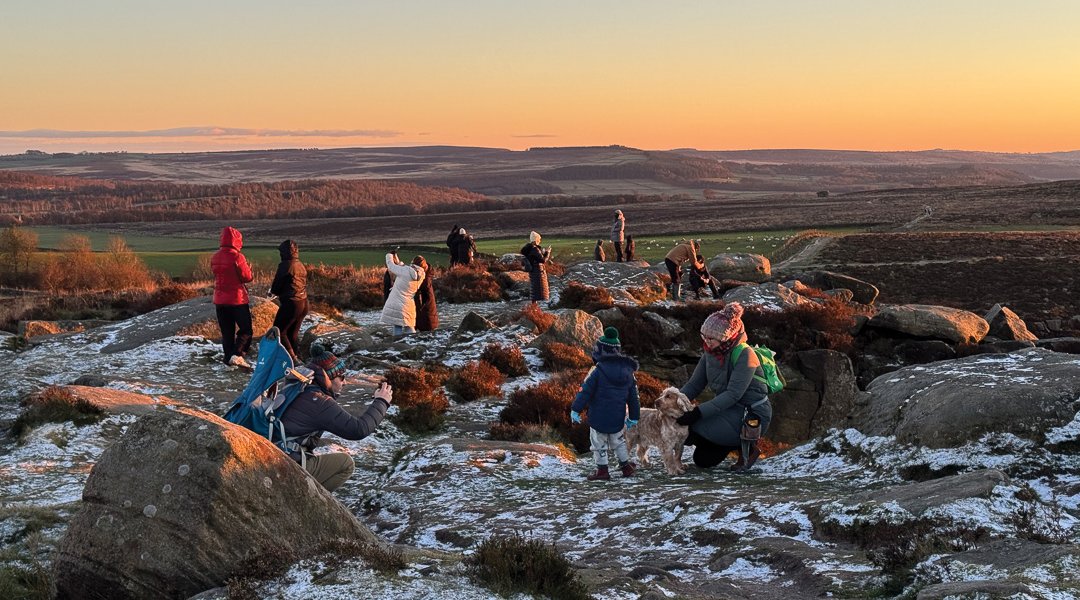
As the sun sets, the boulders and rocks – their layers sculpted by ice, wind and water – emit a red hue. People gather in small groups to photograph their silhouettes among the dramatic rocky outlines. This landscape invokes a sense of exploration and play. A sunset is a natural phenomenon that unifies all humans.