
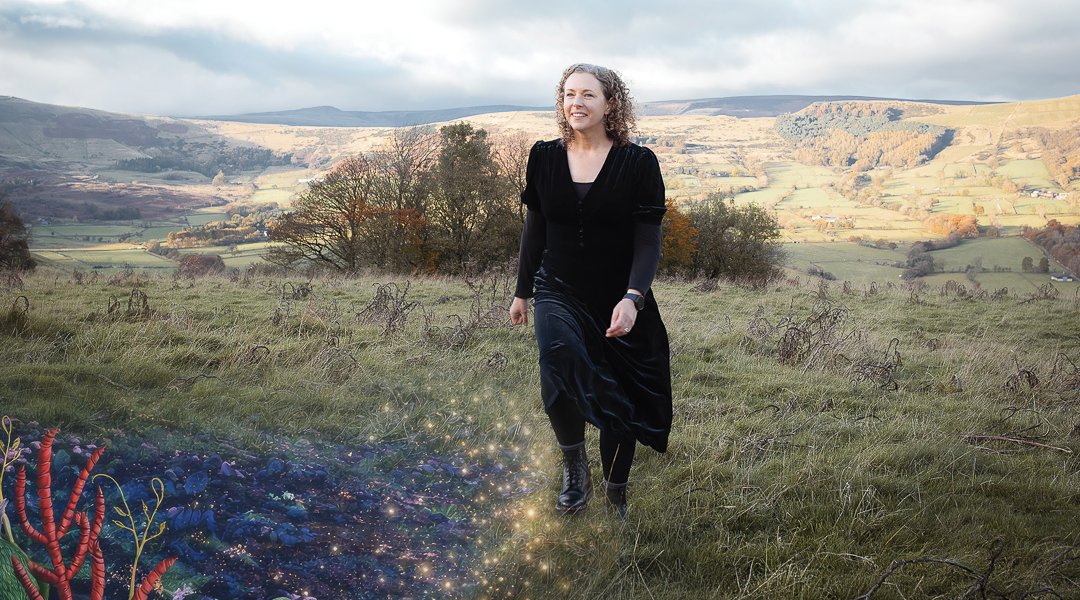
A love of Peak District folklore inspired Anna Caig to achieve her dream of becoming a published author, as she explains to Fiona Stubbs
Peak District author Anna Caig was born to write.
Now her lifelong dream has come to fruition with the publication this month of her debut novel, The Wise Witch of Orkney.
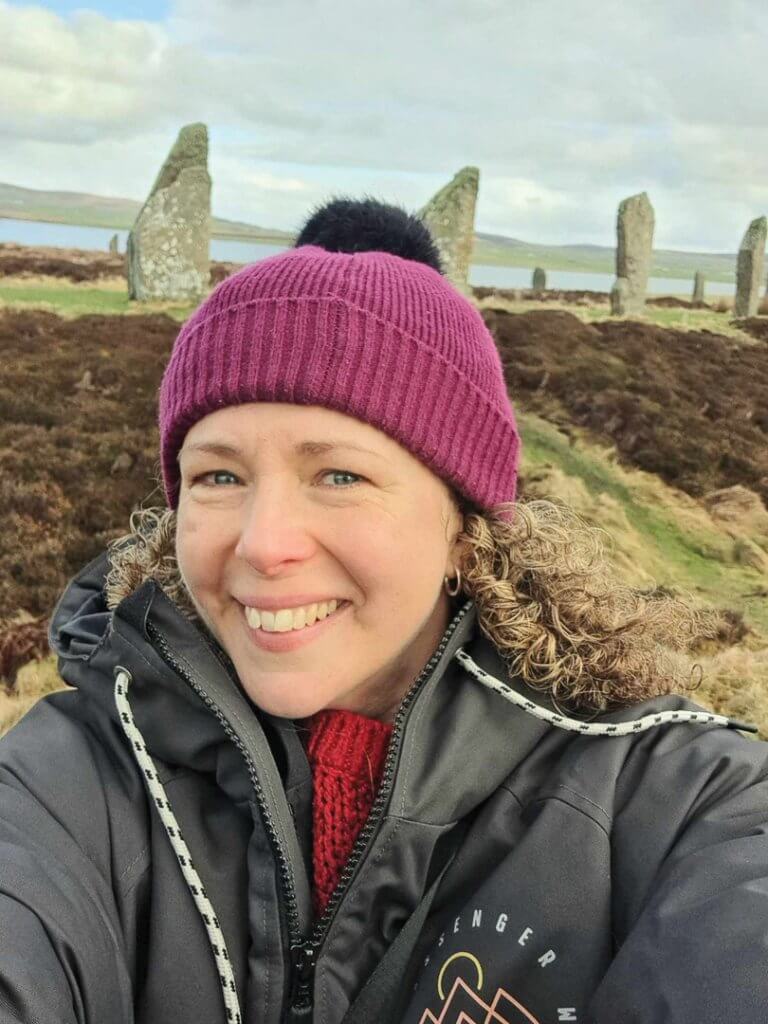
Anna at the Ring of Brodgar stone circle in Orkney
The story is set in Scotland, but Anna’s inspiration was rooted in the landscapes and legends of her Peak District home.
“You can’t help but be inspired by local legends, from the Bakewell witches to the nine ladies believed to have been turned to stone on Stanton Moor for dancing on a Sunday,” says Anna. “My fascination with folklore and witchcraft – and what might have been going on behind the stories – led me to research and write my book.”
The story of the Bakewell witches has intrigued locals for centuries. A Bakewell landlady, Mrs Stafford, and her assistant were hanged in Derby in 1608 after being accused of witchcraft by a former lodger who was found naked and lost in London.
The man claimed he had heard the women performing a ritual which had subsequently ‘transported’ him to London.
It is believed he had actually been evicted for not paying his rent and Mrs Stafford had kept some of his clothes as payment – but his vengeful accusation was enough to seal the women’s fate.
“This story is typical of a lot of the witch trials in scapegoating women,” says Anna. “Women at the time lived with this threat hanging over them. Even if they weren’t actually accused of being witches, the threat affected how they lived their lives, how strong-willed they could be. It was absolutely a way of keeping women down and afraid.”
In The Wise Witch of Orkney, Anna weaves historical fact with fiction in a compelling tale of friendship, deception and adventure.
Set in 1593, it follows Elspet Balfour – a wise woman and herbalist – who is summoned from her island home to the court of the witch-hunting King James VI. She must enter court disguised as a lady-in-waiting to care for the pregnant Queen Anna.
While Elspet struggles to keep h er identity secret in a court that wishes her dead, another woman seeks her aid. Kitty Muirhead, unwed and impoverished, is desperate to rid herself of her burdens past and present. Kitty and the queen could not be more different but, with Elspet’s help, they may be each other’s salvation.
Anna’s interest in Orkney was sparked by Amy Liptrot’s memoir, The Outrun, which chronicles the journalist’s return to her Orkney roots to escape the hedonism of life in London.
“There’s a throwaway line in the book where Amy talks about an island in Orkney where witches were marooned and left to die,” says Anna. “It really captured my imagination. I’ve tried to research the island but have never found anything about it, not even a name.
“I did, however, find a story of a lady called Alison Balfour, who was executed for witchcraft in Orkney in 1594 after being implicated in a murder allegation between feuding brothers.
“I was inspired by her story and started writing a book loosely based on elements of her life. As the story developed, I realised that I wasn’t really writing about Alison but my fictional character, Elspet.”
She adds: “At that point, I’d only been to Orkney once, on a family holiday. I’ve been back many times now for research and have fallen in love with it. It’s a place that really gets under your skin. It sounds cheesy but I get the feeling that, if magic is real anywhere, it’s there.”
What makes Orkney so special? “More than anything it’s a feeling,” explains Anna. “The land is relatively small and seems dwarfed by huge skies. There are so many historical monuments. Skara Brae [a 5000-year-old Neolithic village] is one of the most important monuments in the world, its stone houses preserved by sand until it was discovered in 1850.
“There are stone circles and cairns which are thousands of years old. It’s a place where the present and the past are very connected and where there is an incredibly rich story telling heritage.
“Orkney’s folk tales are so inspiring. Its history is very Scandinavian. At the time my book is set, the queen of Scotland is Danish. Queen Anna of Denmark was brought over to marry King James VI as a teenage bride. That part is true, though I have very much embellished the Scandinavian elements in my book.
“When researching women, there are so many gaps in the records because womenís lives werenít considered important. As a writer, thatís both a challenge and an absolute gift. Thereís a real space for your imagination to take over.”
“When researching women, there are so many gaps in the records because women’s lives weren’t considered important. As a writer, that’s both a challenge and an absolute gift. There’s a real space for your imagination to take over.”
The book also explores how strongly we feel connected to the place we call home. “For Elspet, this is Orkney, and, for me, it is Derbyshire,” says Anna. “What 18th century novelist and journalist Daniel Defoe called the ‘howling wilderness’ of the Peak District and its stories have got under my skin and inspired me to write.”
Anna moved to the Peak District 18 years ago with her family after first discovering it as an English Literature undergraduate at Sheffield University.
She met her husband, Rob, when they were both students at the university. “One of our first dates was a walk in the Hope Valley,” she recalls.
When the couple found jobs in Manchester and Sheffield, they looked for a base between the two cities and made their home in the village of Bradwell.
Anna values the sense of community she has discovered in the Hope Valley. “I’m part of a village book club and a Tideswell-based running club and the support I’ve had from people is really wonderful.”
She enjoyed a successful career in communications – working in the voluntary sector and local government – but writing remained her true passion. “It was my dream from being a little girl,” she says. “I recently found a photograph of myself when I was 10 on a narrowboat holiday with my family. I vividly remember scribbling a ‘novel’ called Mandy’s Midnight Mystery into a small hardback notebook while on that holiday.
“Then, when I turned 40, something clicked. On my 40th birthday I had a realisation that writing a book had been my dream for so long and, not only had I not done it, I hadn’t given it a proper shot.
“I started saving up so I could leave my job. It was a big decision to leave my sensible, secure career and put writing at the heart of my life. That was eight years ago. The Wise Witch of Orkney is the third novel I’ve written, but the first to be picked up by a publisher.
“There are lots of different women in the book – from rich and poor backgrounds; older and younger. I also wanted to explore female friendships. At a time when women had little explicit power, they had to find secret, covert ways to exert agency over their own lives.
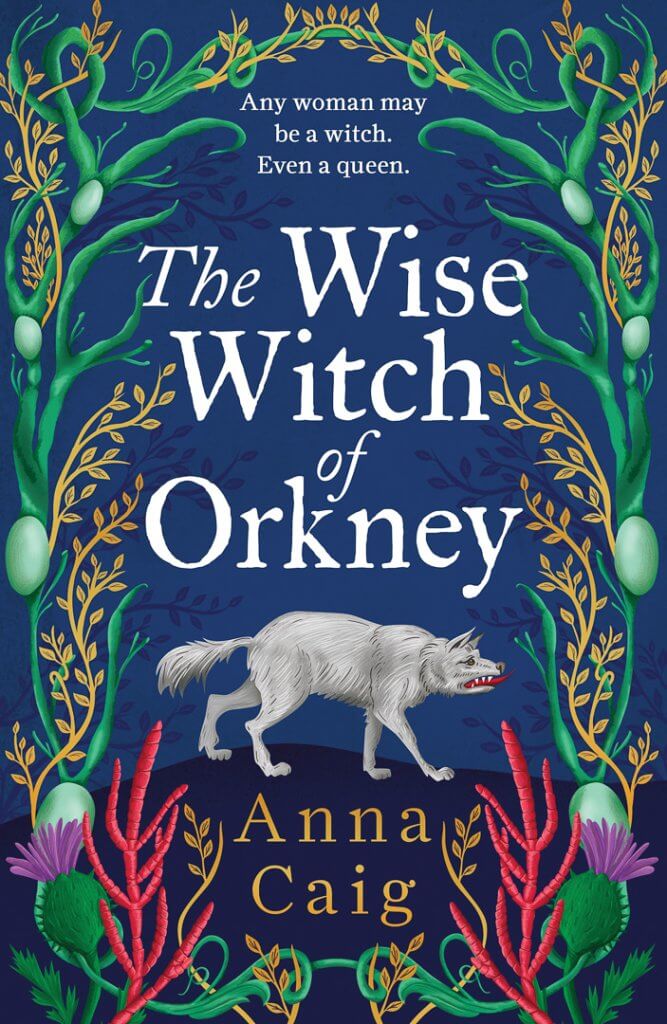
“I really care about depicting women in midlife and beyond as living rich, exciting, adventurous lives. There are several of these in The Wise Witch of Orkney. It’s a story very close to my heart. I feel as though I’ve really found myself in my 40s.”
The Wise Witch of Orkney (Hardback £16.99; Kindle edition £8.99) is published on 26th February by Bonnier Books Ltd. Learn more at annacaig.co.uk