
By Vivienne Milburn FRICS Independent Antiques Auctioneer & Valuer
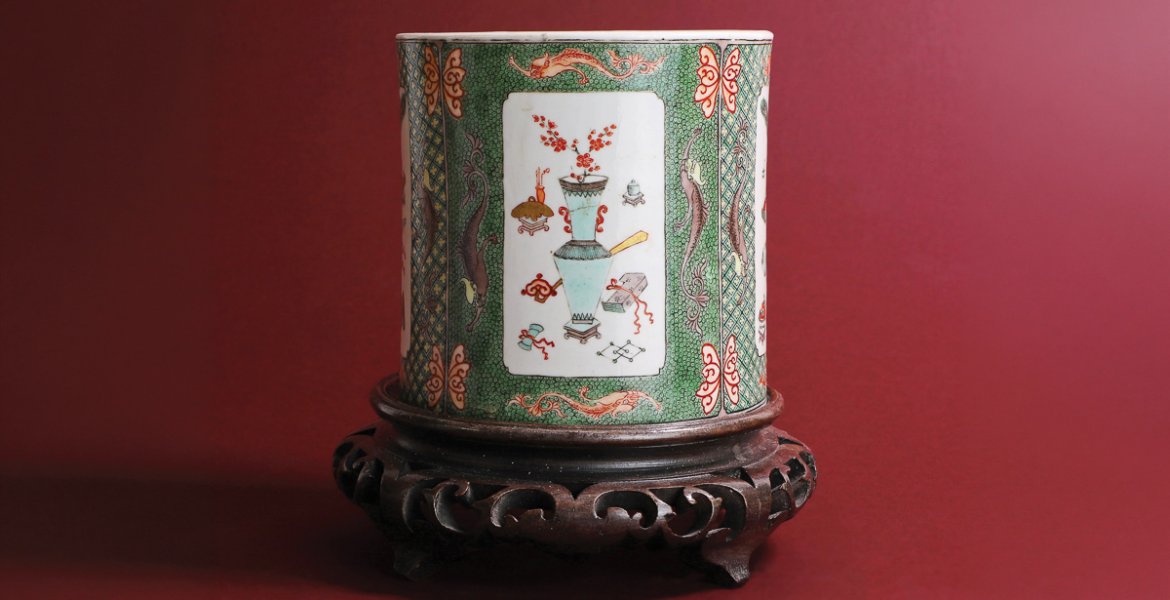
The market for antique silver items is at its highest in 2026, driven not just by the I forget what the plant was in this pot when I found it, but it certainly left plant debris in it. It was the quality of the famille verte decoration that caught my eye and the lustrous surface of the green enamel.
From a property in Calver, it dates from the late Qing (pronounced Ching) Dynasty 1861–1912. It was a turbulent time in Chinese history, however the potters of the era were still producing quality porcelain.
The actual purpose of this pot is as a brush pot, or bitong. They are an essential desk accessory in Chinese scholarly life, used to hold calligraphy brushes. Brush pots decorated in the famille verte palette often depict scenes of scholars, linking them aesthetically and culturally to the scholarly ideals of the Qing period.
Recent auction results demonstrate the range of values depending on quality, provenance and condition, illustrating steady demand for well-preserved examples. Such prices reflect the continuing appeal of scholars’ objects and items associated with the literati culture of late imperial China.
The Qing dynasty was the final imperial dynasty of China, spanning over 250 years. Founded in 1636 in Manchuria, and Beijing in 1644, the dynasty fell in 1912 following the Xinhai Revolution, marking the transition to the Republic of China.
The Late Qing Dynasty marked the final, turbulent era of imperial China, characterised by rapid decline and failed modernization attempts. Plagued by internal rebellions like the Taipings and Boxer Uprising, and disastrous foreign wars, the dynasty collapsed following the 1911 Xinhai Revolution, ending over 2,000 years of imperial rule. Called the “Century of Humiliation”, the Qing lost nearly all conflicts, forcing them to sign “unequal treaties” with western powers and Japan, ceding territory like Hong Kong and Taiwan.
The current auction market for Chinese famille verte porcelain remains active, particularly for high-quality examples from the early Qing dynasty. Famille verte wares, characterised by their vibrant green enamel palette, were particularly prominent during the reign of the Kangxi Emperor 1661-1722. As a result, Kangxi-period pieces command the strongest prices in the international auction market. Examples range from £5,000 to £15,000.
If you require a valuation on your antiques and collectables, it is worth getting the advice of an Independent Antiques Valuer to assess your works of art. For information, please contact Vivienne Milburn on Mobile 07870 238788 or 01629 640210. www.viviennemilburn.co.uk vivienne@viviennemilburn.co.uk