
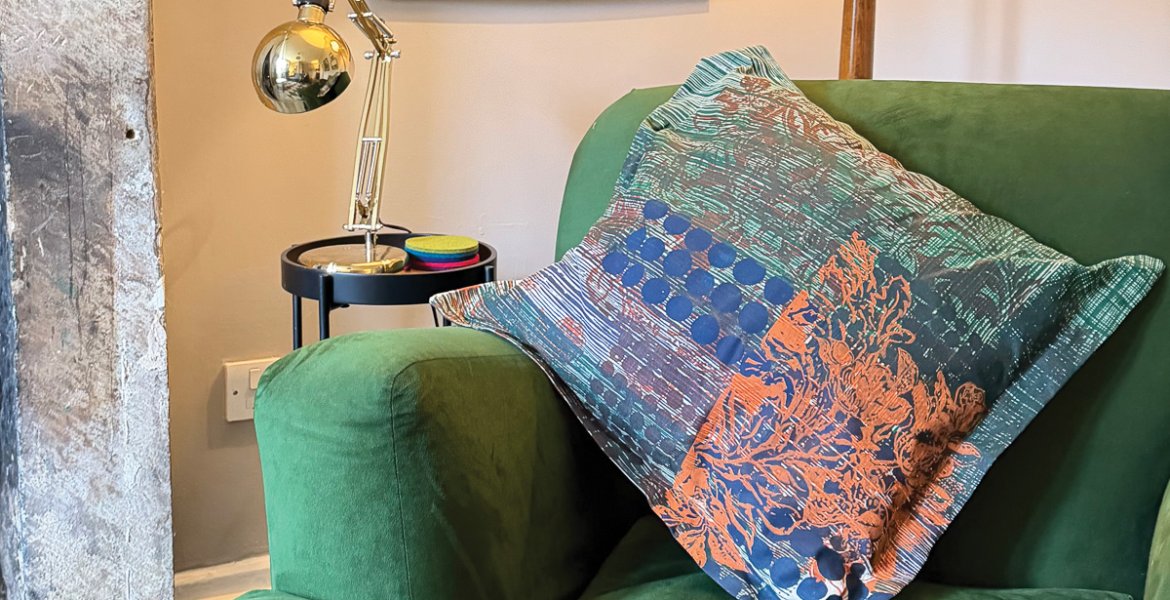
As Sara Kirby developed her range of hand-printed textiles – drawn from the natural world – she found inspiration close to her own roots, as Fiona Stubbs discovers
It’s not easy to concentrate on introductions with Sara Kirby when we first meet in the sitting room of her historic Peak District cottage.
There are so many distractions from eye-catching textiles, demanding to be more closely inspected.
“This is my showroom!” laughs Sara, whose designs adorn cushions, curtains and other fabrics throughout the stone-built cottage in Bamford.
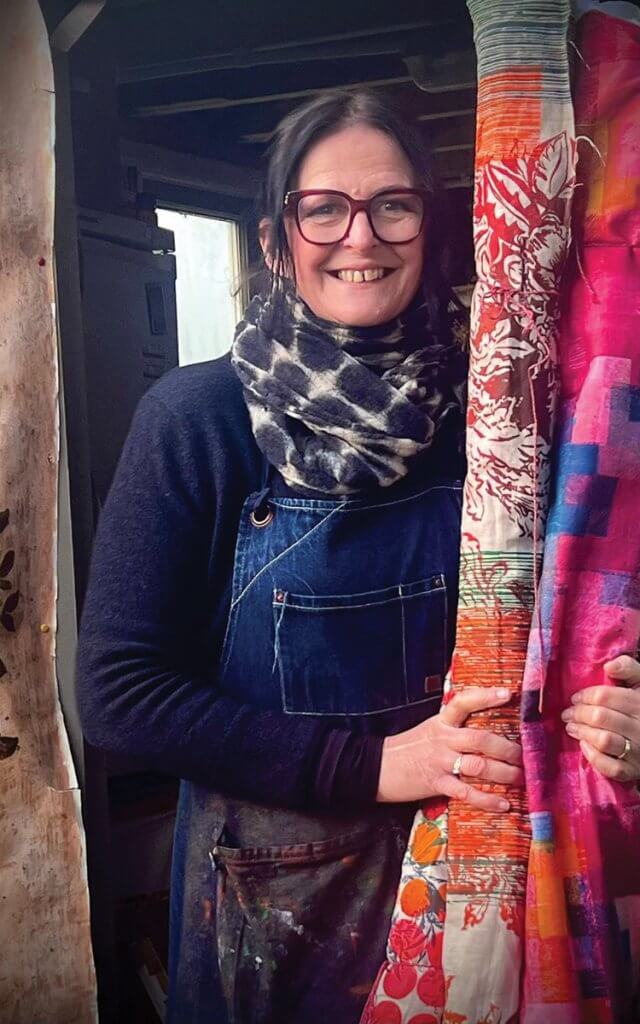
Sara and her husband Paul currently divide their time between the Hope Valley and their family home in Old Basing, Hampshire.
The production side of her business, Loyalty Cottage Studio and Print Workshop, is based in Hampshire. It is where Sara originates artwork, designs and produces hand-printed textiles.
However, Sheffield-born Sara hopes to eventually return to the Peak District to pursue her craft, which is heavily influenced by the Derbyshire countryside.
She shows me a rustic notebook, revealing page after page of pressed botanicals, many collected during walks in the Peak District and along the Derwent Valley Heritage Way.
Sara and Paul, who is also from Sheffield and now works in the film industry, are exploring sections of the Derwent Valley Heritage Way, which runs from Ladybower Reservoir to Shardlow, via Cromford and passing Strutt’s Mill in Belper. It was during these walks that she collected wildflowers, including sweet cicely, which now feature on tea towels and napkins her Pressed Flowers Collection.
“I love that my products are functional” says Sara. “My textiles are observed from the natural world, drawn, designed and then hand printed. My work is both artistic and practical; I like my products to be beautiful and enjoyed, but everything from curtains and cushions to tea towels, napkins and laundry bags are meant to be used.”
Despite a long career in the textile industry and teaching, the seed for Loyalty Cottage was sown during Covid lockdown, when Sara and her family took permitted walks along the South Downs Way, close to their Hampshire home.
“I really noticed the natural world around me,” recalls Sara. “I started to collect and press flowers. As kids, growing up on the edge of the Peak District, we’d walk all the time, but it was only during those brief periods we were allowed out during Covid that I truly appreciated the beauty around us.
“Walking in the countryside soothes my soul and inspires my work, from subtle colour combinations that continually change with the seasons to the shapes and pattern structures of nature. I find that plants and flowers are absolute treasures and it is an obvious starting point to translate the beauty of what I see into my work.”
It was this inspiration that developed a new creativity, leading Sara to establish her design studio and print room. She sourced her own screen-printing equipment, including an exposure unit which fixes drawn artwork on to a silkscreen photographically. “I create the artwork and, when it’s printed onto the fabric, I review the design and question the relationship between the pattern, colour and fabric,” Sara explains. “It is using the screen-printing technique, which helps me to develop ideas further through the adding of layers of print imagery for extra texture and colour.”
Sara grew up in Sheffield where her dad was a teacher and then a headmaster, working in several schools across the city. Her mum taught needlework, so fabrics were always around. “I wasn’t very academic at school, though, and I didn’t know what I wanted to do for a career” she says.
Still unsure of a career path after working in London for a while, Sara returned home to her parents and enrolled on an Art Foundation diploma course at Chesterfield College.
“I don’t think my parents were very impressed, initially, as no one in the family had worked in the creative field before,” she remembers. “I knew it was make or break for me when I got to Chesterfield. I really went for it and worked incredibly hard.”
She went on to achieve a degree in Fashion and Textiles from Manchester Metropolitan University and says: “By the time I got to Manchester, I knew I had found my niche.”
After graduating, Sara worked in the textile industry in Bolton as a designer and print room manager. Then, when Paul got a bursary to the National Film and Television School to study Production Design, Sara also relocated to London and worked for Warner Fabrics.
Having experience of working with printing mills, she produced a collection of co-ordinating fabrics and wallpapers based on archival documents. The company was by appointment to The Queen, because it had supplied fabrics for the coronation in 1953 and Sara was involved in designing furnishing fabrics for the Royal Household at Balmoral.
Head hunted by Brighton-based Crowson Fabrics, Sara went on to work in design, marketing and product development and worked with clients including Marks & Spencer and John Lewis. She contributed to the company gaining the prestigious Queen’s Award for Enterprise for export marketing. Now called the King’s Award, it recognises British businesses and other organisations which excel at international trade, innovation, sustainable development or promoting opportunity.
After having her three children, Sara retrained as a teacher, working in further education and a sixth form college. She taught an applied multi-disciplinary course, with subjects including textiles and graphics, and held drawing and printing workshops. She became an Arts Education Co-ordinator, helping students to build their portfolios and gain work experience. “My biggest joy was when students came back to me and said they’d got a place at university,” she says. “I felt that they were ‘launched’.”
In 2012, Sara achieved an MA in Art and Design History yet admits she’s still learning.
“Having worked in mills in Lancashire, I thought I knew all about the textile trade but, through our walks on the Derwent Valley Heritage Way, I’m learning more about the origination of the textile industry,” she reveals. “There are so many fascinating facts including the origins of water powered cotton spinning at the UNESCO world heritage site at Cromford Mill and the birthplace of the modern factory system.
“We moved to the south to work, but now we’ve got the luxury of coming back. I think I appreciate Derbyshire more now, having lived away for so long.
“We have family commitments in Hampshire but, ultimately, I’d like to be based here. My heart is here. When I come back to Derbyshire, I can breathe; my shoulders go down and I feel at home.”
The county continues to inspire Sara as she develops her brand of bespoke textiles. “Perhaps I’m at an age where I can think and reflect and see it as an alternative to mass produced textiles,” she says. “For the Master’s degree, I did a comparative study between digital and hand printing. Digital is fantastic for big business as it can be produced so quickly, but limited in meaning and connection to the world.
“So, I’m moving away from mass production and my work reflects the importance of things I see around me. I’ve been learning about Arkwright, who started the mill that fed the early textile industry and now, I suppose, I’ve come full circle.”
Learn more at www.loyaltycottage.com