
Familiar Peak District landmarks take on an almost otherworldly quality in Beth Rippin’s striking night-time photographs, as Steve Brown reveals

Beth Rippin is a photographer whose work reveals familiar Peak District landscapes in extraordinary ways, making otherwise inaccessible moments of light, textures and atmosphere visible through photography.
I just cannot imagine anyone who sees her illuminated night time portraits of rock tors, edges, boulders and towers in the Peak District for the first time as being other than utterly amazed at what she has so far achieved.
Inspired by a lifelong connection with the outdoors, Beth has developed a distinctive photographic practice that reveals overlooked details and invites us to look again at places we think we already know.
Beth grew up in Chesterfield, where her parents’ love of the outdoors meant regular trips to the Peak District from an early age. Despite the rain, wind and memories of being so cold she couldn’t take her shoes off, these outings gradually nurtured her own affection for the landscape.
Her artistic interests developed throughout her school years before she went on to study Fine Art at the University of Leeds. While at university, Beth worked part-time for the well-known Chesterfield artist Sheila Gill, gaining valuable experience of the art world through exhibitions and website work. It was also during this time that she began exploring photography as another artistic medium.
Evening rock-climbing sessions with her father and friends during the longer summer months encouraged Beth to experience familiar landscapes in a completely different way. Walking back to the car through the soft, fading light made her realise how dramatically the landscape changed after dark, prompting her to consider how, through photography, she might communicate that experience to others.
Rock climbing has also given Beth an intimate understanding of these gritstone formations, allowing her to see them not simply as landmarks but as sculptural forms shaped over millions of years by weathering and erosion. This close relationship with the rock itself continues to influence the way she photographs the landscape today.
A turning point came while walking through thick Peak District mist, where the rocks often became the only visible features. Rather than seeing the landscape as a broad panorama, Beth became fascinated by these sculptural forms and the way darkness and limited visibility transformed familiar places into something almost otherworldly. Her work has since become rooted in walking and observation, using light not simply to illuminate the landscape but to reveal moments, textures and perspectives that often go unnoticed. Through her photography, she hopes to encourage others to slow down and see familiar places in a new way.
Many of the tors Beth photographs are among the Peak District’s best-known landmarks, visited by thousands of walkers each year. Yet her work asks us to look beyond the familiar viewpoints and sweeping panoramas to appreciate the rocks themselves. By isolating them in darkness, details that often disappear into the wider landscape during daylight suddenly become the focus of attention. The result is not simply a record of a place, but a fresh way of experiencing it.
Although Beth often visits locations in daylight to become familiar with the terrain, her work develops through walking and responding to the landscape rather than meticulously planning individual compositions.
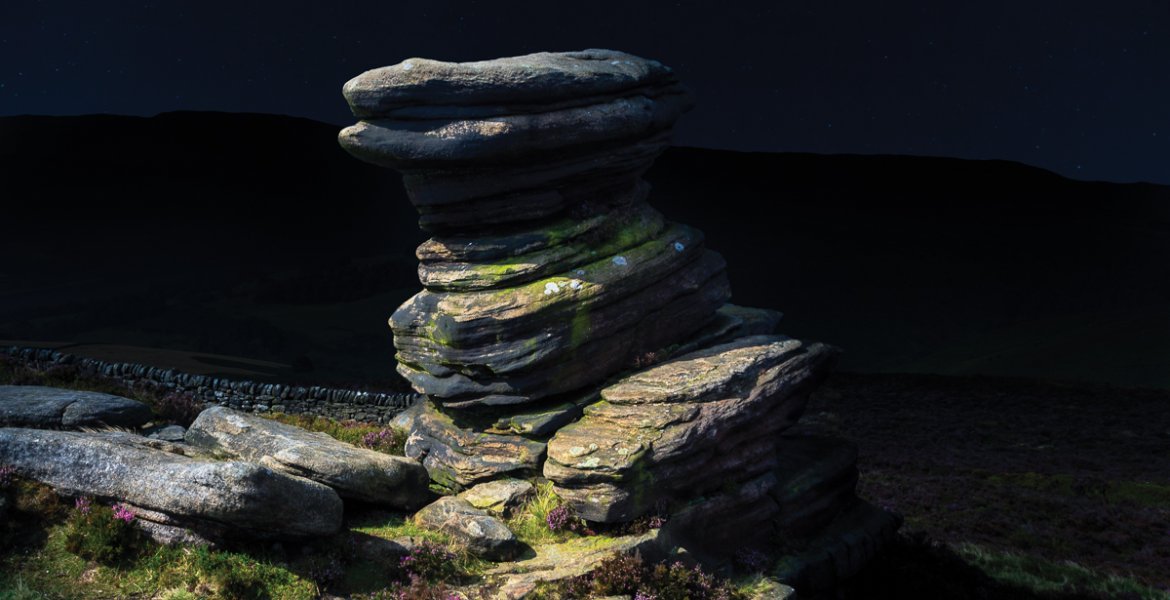
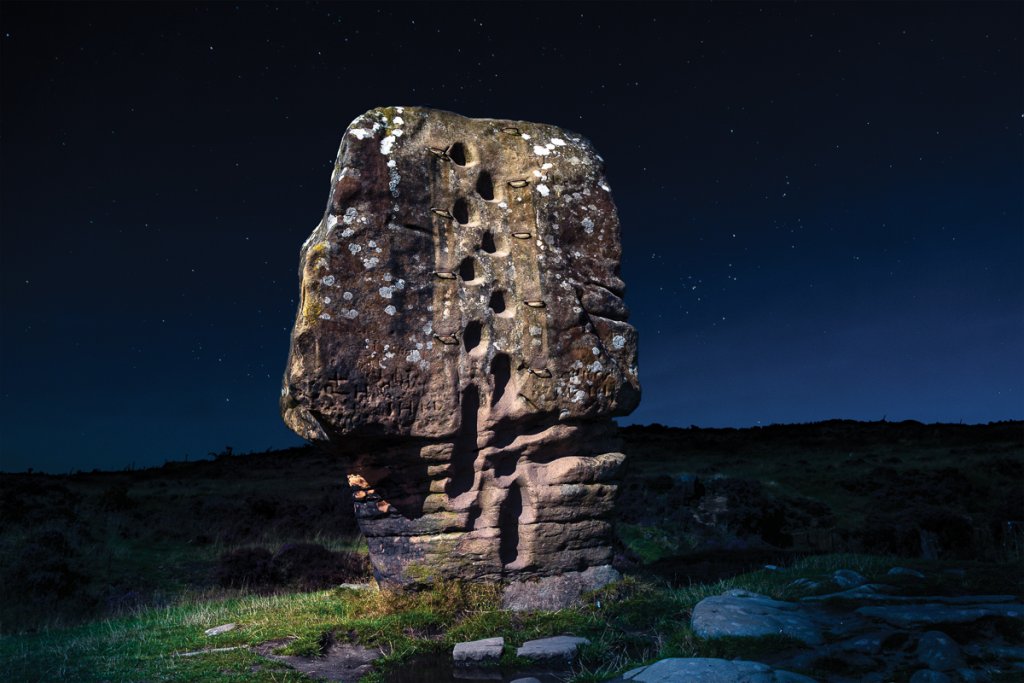
Working after dark, she uses long-exposure photography and carefully controlled light to reveal details that are easily overlooked during the day. Darkness strips the landscape back to its essentials. With sweeping views and distant horizons disappearing into the night, the rocks become the true protagonists, their textures, colours and sculptural forms emerging with remarkable clarity. Familiar landmarks are transformed into intimate portraits, inviting us to slow down and look more closely at these places in an entirely different way.
Her portrait of the Salt Cellar on Derwent Edge is a case in point. Most photographs of this famous tor celebrate its wonderful situation high above the Upper Derwent Valley, with the arm of Ladybower Reservoir stretching out below. Beth’s portrait is taken from a different angle, drawing attention instead to the tor’s sculptural form, the folds and creases of the gritstone, the rich green mosses and the way its summit cap seems almost to float above everything else.
Given that she works at night, Beth’s photographs often require long exposures, meaning she can spend considerable time with each subject before retreating from the darkness to the warmth of a waiting bed.
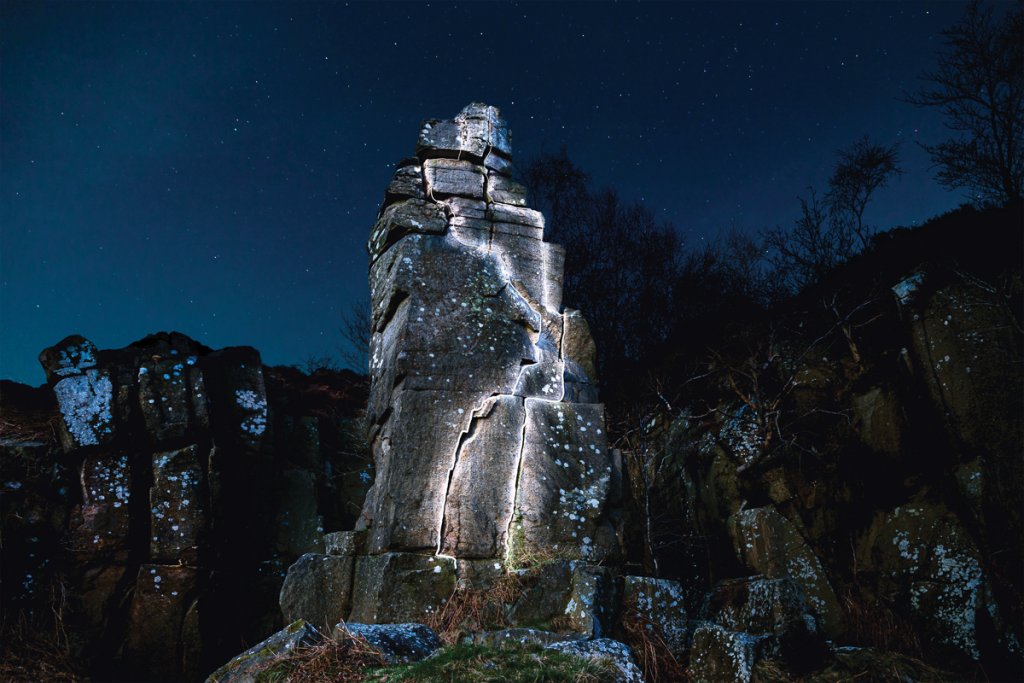
I expected her to tell me about the travails of carrying floodlights and power packs to illuminate the rocks, so I was astonished to discover that the lighting comes almost entirely from the head torches used by Beth and those accompanying her. The only exception so far has been the use of battery-powered white fairy lights, which her abseiling father carefully placed into the cracks of rocks on Burbage Edge and the Tegness Pinnacle near Froggatt Edge while suspended on a climbing rope, highlighting those features to great effect.
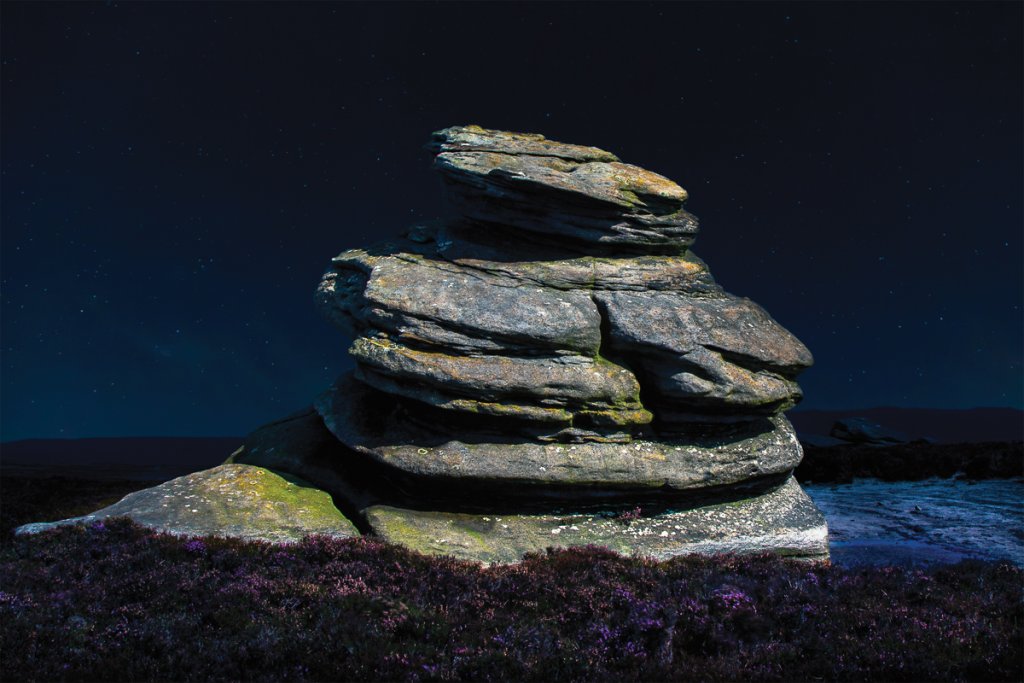
Beth sees the Peak District tors, edges and pinnacles continuing to be the focus of her night time work, believing there are still countless rock formations waiting to be discovered after dark. Given their remoteness, some might require a considerable commitment to reach, let alone photograph. Alongside this ongoing exploration, she hopes to develop her work further through wide-angle images and has also begun exploring the landscapes of the Lake District, producing striking monochrome photography and atmospheric images of mountains emerging through cloud.
Her photographs are available through her own website, and in 2025 one of her works was selected for the Leeds Art Gallery Ben Read Acquisition Award, becoming part of Leeds Art Gallery’s collections, and it’s currently on loan to Leeds Central Library as part of Story Explorers. Whatever direction her photography takes next, I am sure that it will be innovative and exciting, and we should wish her well for her artistic future.