
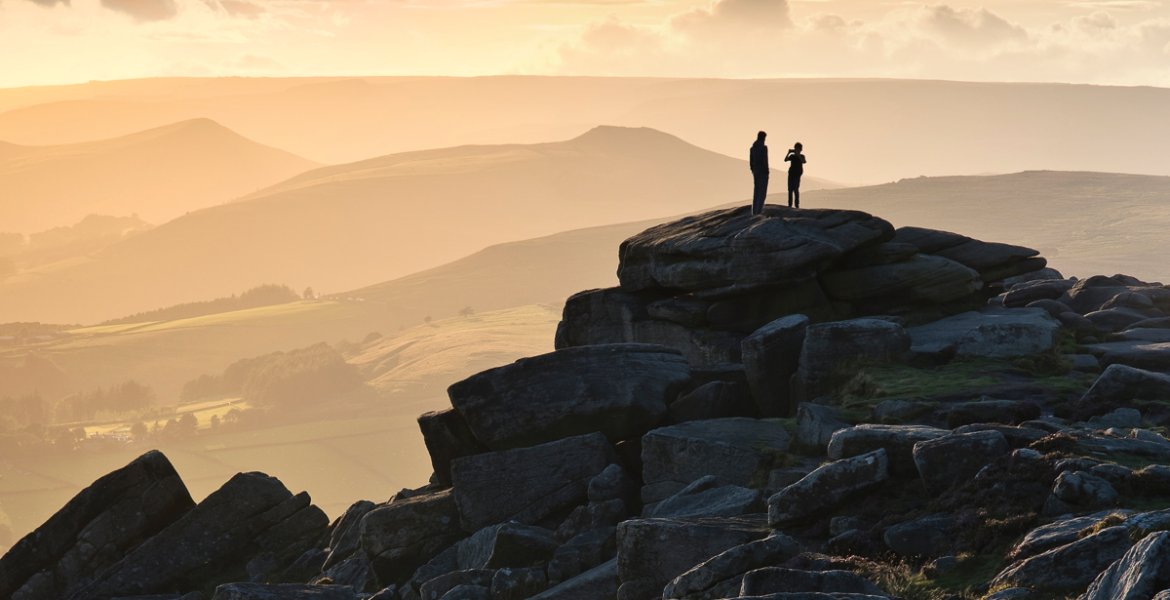
Wild, weather-beaten and steeped in history, Stanage Edge is a place where climbing legends were made, Charlotte Brontë found inspiration and centuries of human endeavour remain etched into the stone. Peak District writer, mountaineer and photographer Chris Drabble shares his impressions of this iconic landscape
Stanage Edge rises from the eastern moors of the Dark Peak, slicing through the horizon like the spine of a remote and fiercely defiant defensive wall.
Weathered by relentless winds, and defined by an endless sky, there is an unerring grandeur to it. The gritstone edges stand as if keeping watch over the rolling landscape below, isolated as if from time itself. The elevated air is fresh and wild and carries the cries of curlew and red grouse, while the echoes of the past drift upon the breezes that weave through the gritstone crags.
Stanage Edge has been a climbing mecca for over a century. The sport began here in the late 1890s, with pioneers Jimmy Puttrell and H.M. Kelly among the first to establish rock climbing on the edge.
In the early 20th century, Geoffrey Winthrop Young helped shape British climbing through route-grading standards and illustrated guidebooks. His work was influential in the foundation of the British Mountaineering Council.
In a golden age during the 1950s and 1960s, climbers such as J.B. Barford, Don Whillans and Joe Brown cemented Stanage’s reputation as one of Britain’s premier climbing venues through a series of bold and influential ascents.
Over time, Stanage became one of the world’s most extensively documented crags, with more than 2,000 recorded routes.
In 1992, Ron Fawcett completed the remarkable 5,000-metre Girdle Traverse along Stanage Edge. He solo traversed each buttress without touching the ground or the top of any crag within a remarkable time of 6 hours 10 minutes.
Today, Stanage Edge is owned and managed by the Peak District National Park Authority [part of the Stanage-North Lees Estate] and remains a world-renowned destination for traditional climbing and bouldering. It is regularly referred to as the most famous gritstone edge in Britain.
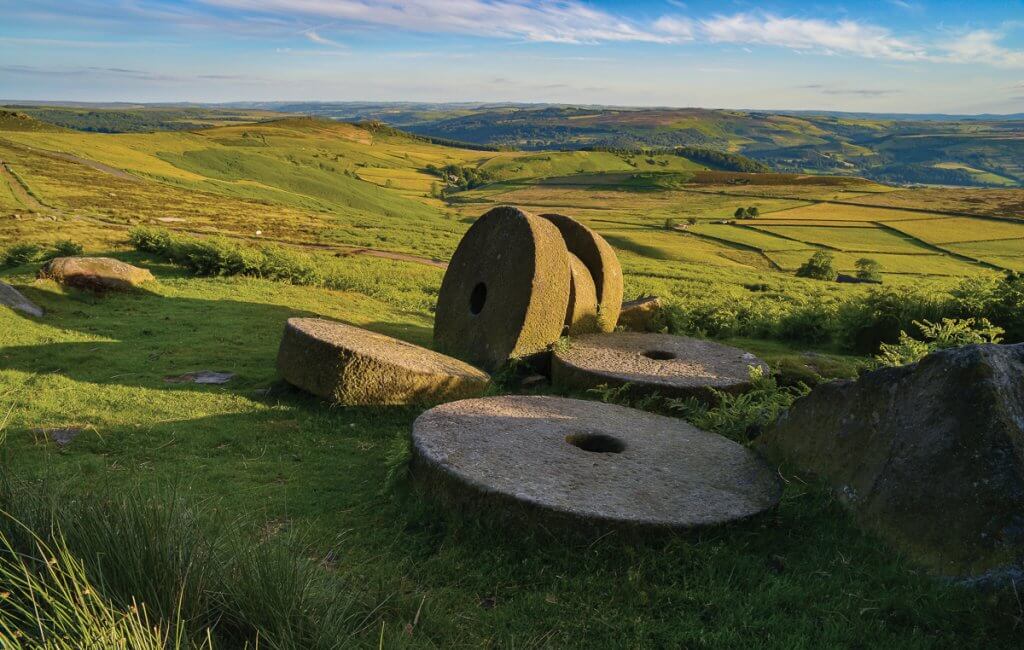
Millstone production at Stanage Edge likely began in the medieval period, with records of quarrying in the Peak District dating back to the 13th century. The abandoned millstones beneath Stanage are remnants of this long quarrying tradition.
Production expanded during the 18th and 19th centuries, when Peak District gritstone was prized for grinding grain and sharpening tools.
By the late 19th century, advances in steam power and industrial technology reduced demand for millstones. This, combined with the competition of cheaper imported stones, led to the rapid decline of Derbyshire’s millstone industry.
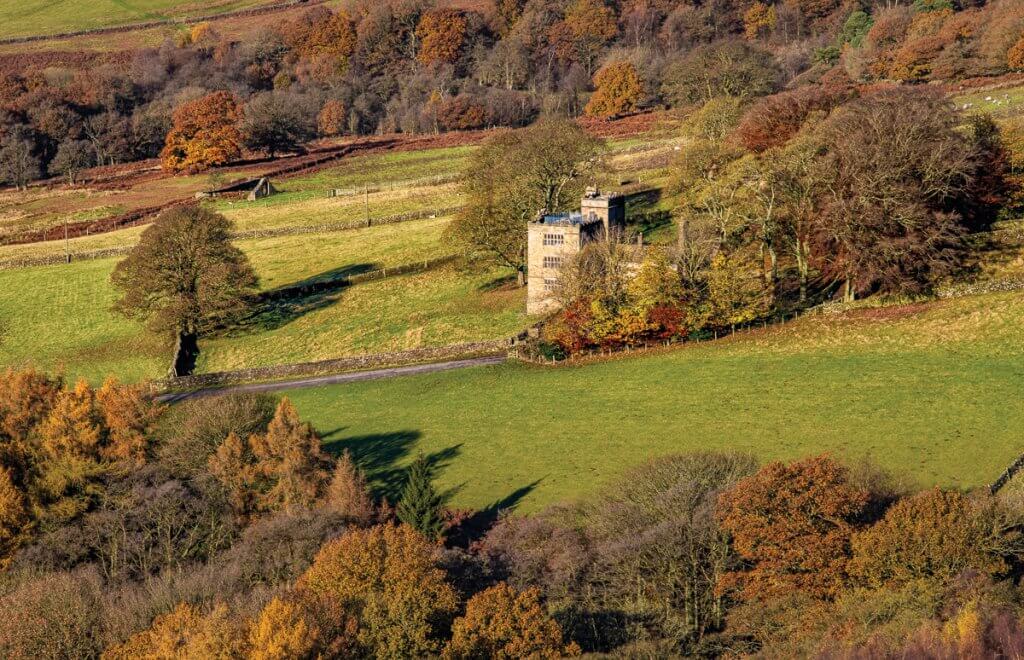
Sitting in a sheltered valley beneath the dramatic gritstone escarpment of Stanage Edge stands North Lees Hall, a Grade II* listed Elizabethan manor house widely believed to have been Charlotte Brontë’s primary inspiration for Thornfield Hall in her classic novel, Jane Eyre. Brontë visited the hall in 1845 while staying at the vicarage in Hathersage, where the Reverend Carus Wilson served as curate.
The hall was occupied by the Eyre family, whose surname Brontë later gave to her heroine, Jane Eyre. In an inspired act of poetic licence, Brontë transformed North Lees Hall into the fictional Thornfield Hall. She derived “Thorn” from an anagrammatic reworking of “North” and replaced “Lees” with “Field,” since “lees” is a traditional Derbyshire term for a field or open grazing land.
The remote grandeur of Stanage Edge provided the backdrop for one of cinema’s most iconic scenes, where Keira Knightley as Elizabeth Bennet, in the 2005 adaptation of Jane Austen’s Pride & Prejudice, stands alone upon the windswept ridge, framed against the vast moorland panorama.
Looking to the future, in June this year, outdoor clothing company Rab, working alongside the British Mountaineering Council and the Peak District National Park Foundation, joined a major conservation effort at Stanage Edge.
Volunteers and staff helped manually carry and wheelbarrow over 8 tonnes of aggregate to restore eroded climbing landings at bouldering sites along the edge. This collaboration across brands, conservation organisations and park authorities is shaping a sustainable future and is a great example of how outdoor culture and conservation can go hand in hand in preserving the landscape for future generations.
*With thanks to Vaughn Smith and Dean Roberts of Bassetlaw Hill and Mountain Club for inspiration and background information.
See these and more images from Chris Drabble at: https://www.photo4me.com/profile/1907
Curiosities of Stanage Edge
The Buck Stone
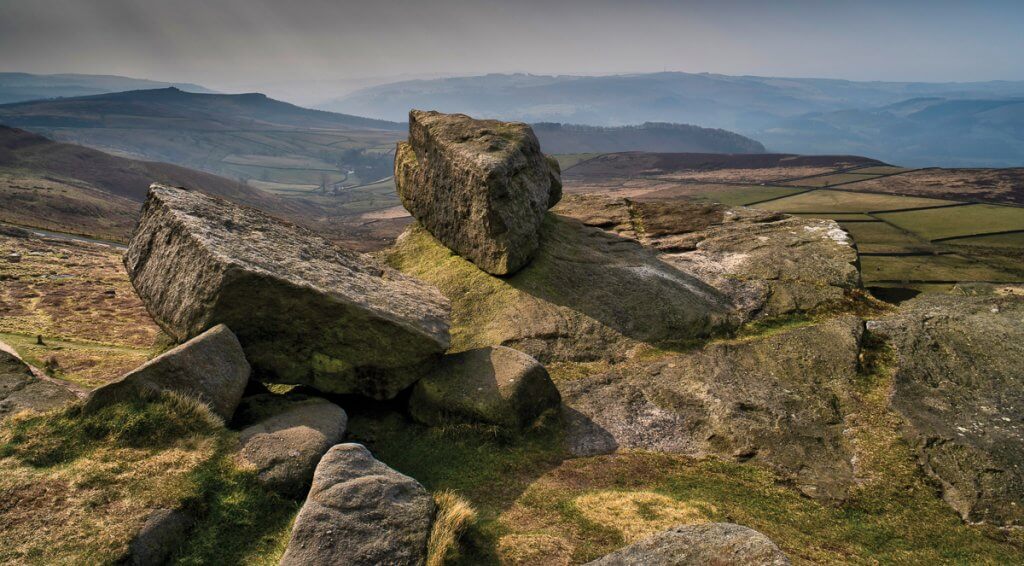
This is a large, isolated, prominent boulder, located south of High Neb. As early as the 17th century, it was used as an overnight shelter, a watering place for packhorses and a moorland inn serving as an unofficial alehouse. The vertical faces of the boulder still feature large rectangular sockets and grooves cut into the gritstone that supported roof rafters and floor joists. Archaeologists and historians believe it acted as a focal point and rest-stop for packhorse drivers travelling along the 18th-century trail between Hathersage and Sheffield. There are various historical inscriptions and carvings on the rock including one dated 1666, as well as a crude “stick-man” carving near the centre of the boulder’s “distinctive” flat top.
Grouse bowls
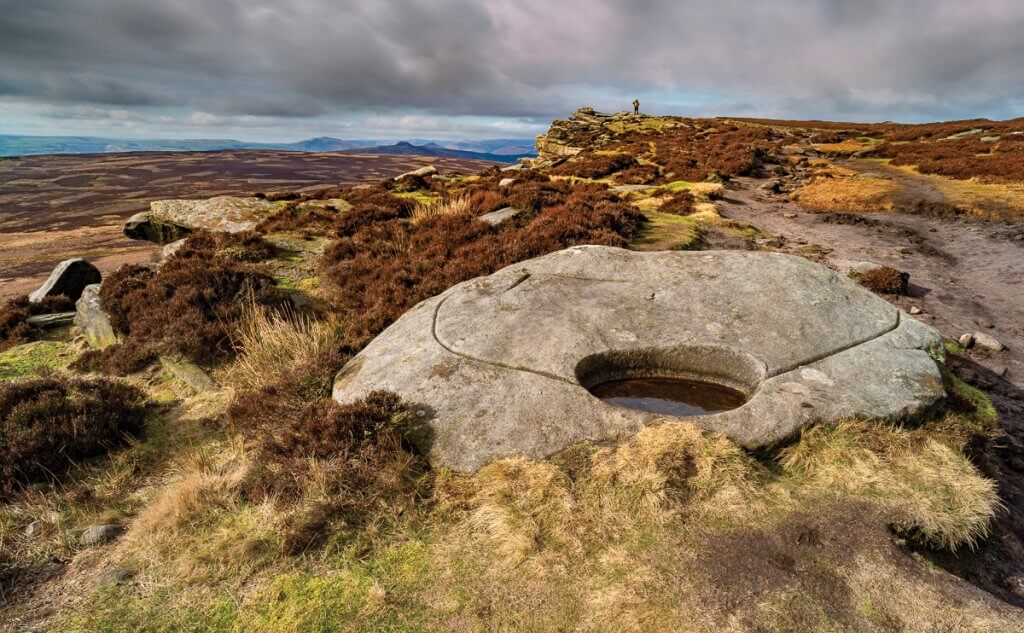
There are over 100 circular water holes or “drinking bowls” carved strategically into the gritstone surfaces of boulders and ledges. They feature cut grooves (runnels) that catch and channel rainwater into a central basin to provide a water source for red grouse. The bowls were cut by gamekeepers and local stonemasons (most notably George Broomhead) at the turn of the 20th century. They were commissioned by the landowner William Wilson, a wealthy Sheffield snuff manufacturer who paid one old penny for the completion of each bowl. Wilson owned the Stanage and Hallam moors and used the estates for private grouse shooting.
Robin Hood’s Cave and Robin Hood’s Balcony
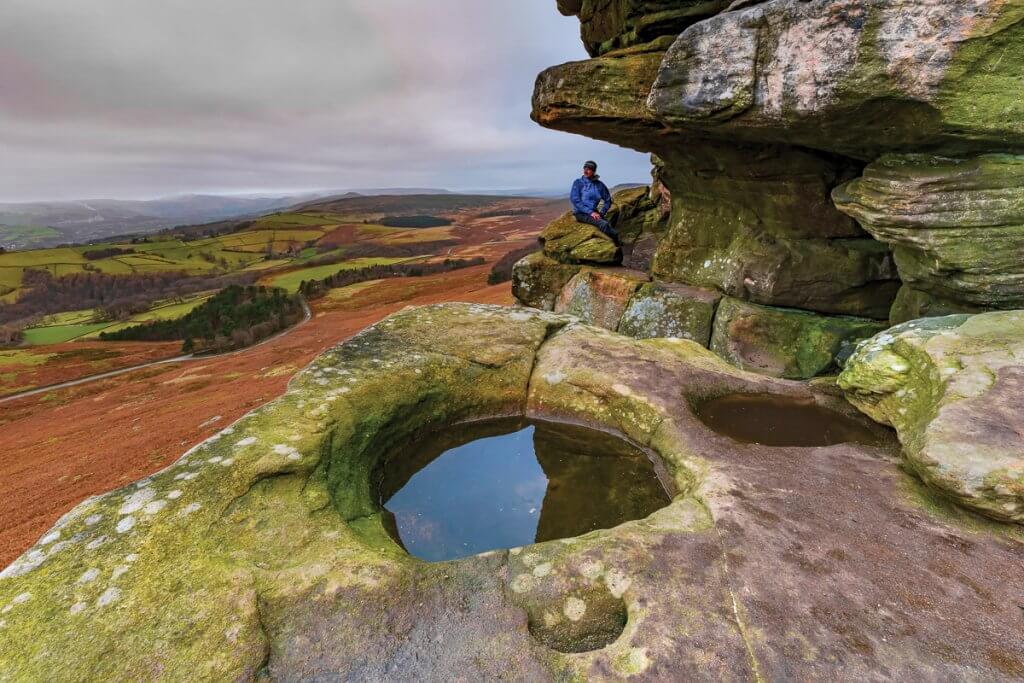
Robin Hood’s Balcony is easily reached by descending a series of natural steps that traverse the cliff edge. However, visitors wishing to explore the balcony must first negotiate a small chamber with a narrow entrance, which often contains a shallow pool of water. This minor inconvenience, together with the possibility of a few scuffed knees, is well worth the effort, as the balcony provides a commanding viewpoint with stunning views across the Hope Valley and towards the hills beyond.
Many people mistakenly refer to the entrance chamber of Robin Hood’s Balcony as Robin Hood’s Cave, which is a separate feature to the north of the balcony. Although the cave and the balcony lie in close proximity, and the temptation to visit both may be strong, the descent to the cave should not be undertaken lightly.