
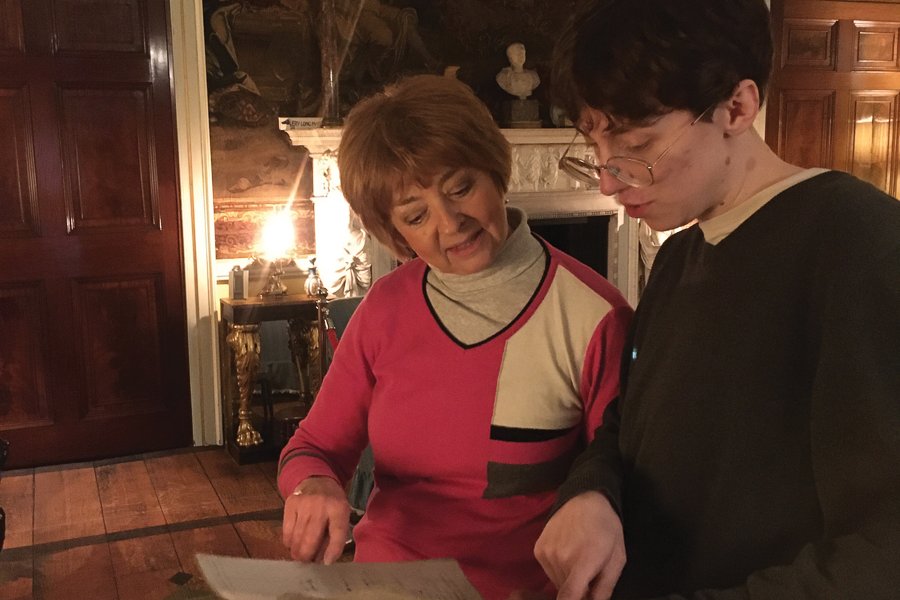
Every faded letter, forgotten diary and fragile sketch holds another piece of Renishaw Hall’s remarkable history. Nicola Doughty meets archivist Christine Beevers who is uncovering the lives, loves and losses hidden within 400 years of family archives.
In a room overlooking the grand Italianate gardens of Renishaw Hall, Christine Beevers works through boxes of centuries-old diaries, letters and documents, barely noticing the view beyond.
A self-confessed ‘nosey parker’ and dedicated myth-buster, she is in her element as archivist of the 400-year-old listed hall. There’s nothing she enjoys more than delving into history. Each envelope she opens and each piece of paper she unfolds offers another story waiting to be uncovered.
“It’s like a huge jigsaw,” she says. “I pick up a document and then try to work out how it fits together with all the others.” For Christine, the thrill lies not just in preserving history for future generations, but in piecing it together.
And there’s a whole lot of history to discover within the documents held within the Muniments Room.
Dating back to the early 1620s, the original Renishaw Hall was built by wealthy ironmaster, George Sitwell. Over the years, it has been altered, modernised and extended by a succession of Sitwells and various branches of the family. It’s little wonder that it holds more than a few stories.
A small nameplate on the door to the Muniments Room offers a nod to its illustrious history. It reads The Duke’s Room, while the neighbouring room is labelled The Duke’s Dressing Room. These were the suite of rooms used by the 6th Duke of Devonshire during his regular visits to Renishaw in the 19th century to see his godson, Sir Reresby Sitwell 3rd Baronet (1820-1862).
“There are stories to be found in every room,” explains Christine. “I enjoy piecing together all the documents and learning more about the people that called Renishaw home, with its fascinating collection.”
Christine picked up the mantle as archivist in 2010. She had joined Renishaw Hall as a volunteer three years earlier, became a tour guide in 2008 and, in 2010, offered to help with an exhibition about the history of the garden.
“Head gardener, David Kesteven, suggested I might find some useful information in this very room. Useful? It was filled with 400 boxes crammed with all sorts of interesting information and paperwork!” she laughs.
Renishaw’s current owner, Alexandra Sitwell, came to the hall in 1965. Her parents Sir Reresby Sitwell, 7th Baronet, and Lady Sitwell discovered rooms filled with papers and historical documents. And while they made the hall their home, they began to develop an archive from this treasure trove of paperwork. Decades later Alexandra enthusiastically continues their work.
It is fair to say Renishaw has been home to some fascinating characters, and Christine has come to know many of them well through the documents and artefacts within the hall. One of her favourites is Sir George Sitwell 4th Baronet (1860-1943), the father of the famed Sitwell literary trio Edith, Osbert and Sacheverell, and great grandfather to Alexandra.
“Sir George is a fascinating character. He is often portrayed by his children and other writers as a comic, eccentric figure of fun but, from what the archives have revealed, he is far from that. He’s incredible.”
Edith, Osbert and Sacheverell Sitwell were prominent cultural figures throughout much of the 20th century. Acclaimed writers and poets, they also championed many of the avant-garde artists and creative voices of their time.
“The archives span more than three centuries – a never-ending work-in-progress,” says Christine.
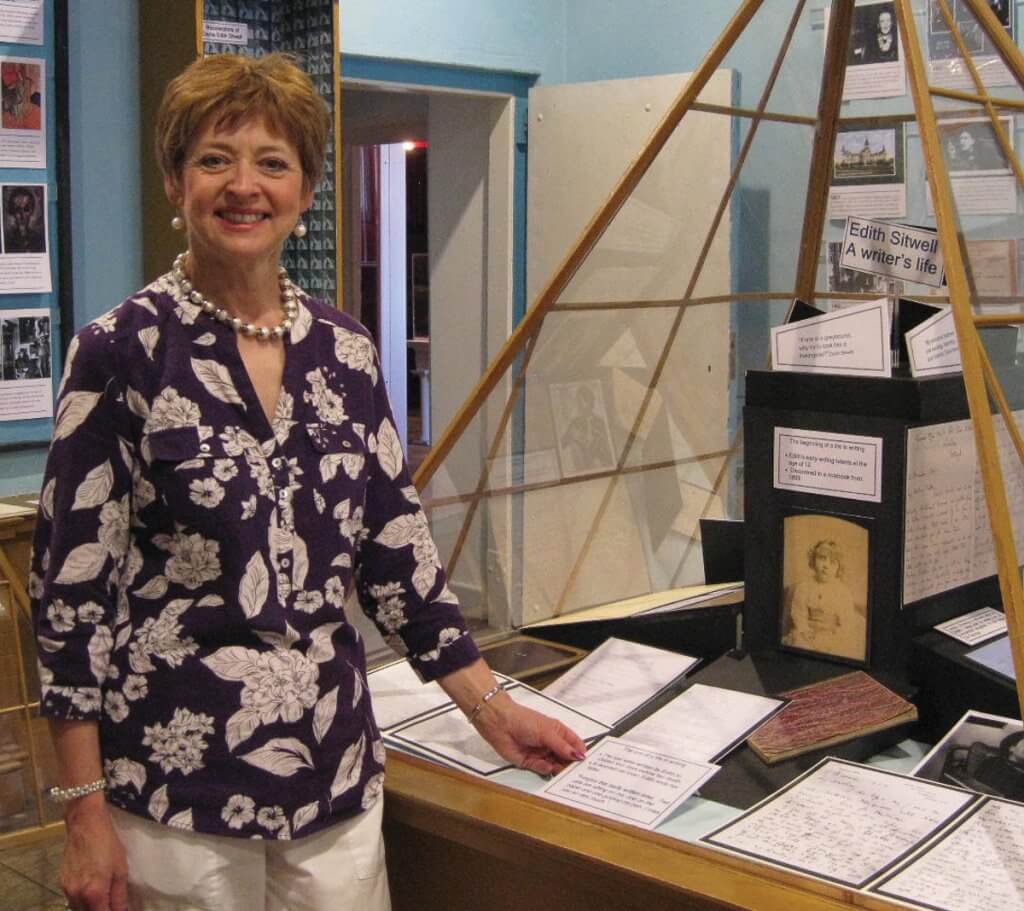
The hall has an endless source of stories to share, many of which feature in guided tours, special group visits, exhibitions, talks and events. Christine has also created and curated regular exhibitions to share the family, hall and estate cultural and garden histories with visitors in the onsite museum. “After a long career in education, being Renishaw Hall’s archivist/curator has been a fusion of both my education background and my passion for history. I enjoy inspiring people to find out more about the past. Here, we’re in the business of retelling stories for the first time in centuries,” Christine explains.
“Alexandra and I share a passion for using the archives and may other sources to reveal more layers of Renishaw and her family’s history.”
This year, in addition to the busy programme of tours and events, Renishaw’s museum is hosting a special exhibition. External curator Alan Powers has created a new exhibition focusing on the ballet the Triumph of Neptune, written by Sacheverell Sitwell, Alexandra’s grandfather. It includes original costumes from the Russian Ballet that are now more than 100 years old.
‘Golden nuggets’ of information can make a surprise appearance at any time. A chance comment from a visitor can often add a missing piece to Renishaw’s heritage puzzle. And then there are Pat and Sheila, the hall’s long-serving housekeepers, and the gardening team who are all a mine of invaluable knowledge.
Sometimes, little clues to the hall’s past emerge by accident, sending Christine down another rabbit hole of research.
There was a time when the maintenance team were removing panelling to carry out work and inadvertently unveiled the original William Morris wallpaper hidden behind since the 1890s.
“It’s always a huge thrill to discover things that have been hidden away for so long,” Christine continues. “It’s also a real privilege to be the first person to read documents that have been in storage for hundreds of years. I often wonder whether the writer ever imagined that their words would be read some 300 years down the line.”
These discoveries also come with a huge responsibility over the public versus private nature of a family archive. Some are deeply personal, such as a 1797 letter written by Alice Sitwell, the first wife of Sitwell Sitwell, the 1st Baronet. She wrote it to her husband on her death bed.
Had documents such as these not been preserved, these insights might easily have disappeared into the mists of time. Among the hundreds of surviving records are the original sketches drawn by Sitwell Sitwell, illustrating his dreams for the Gothic Lodge. These sit alongside the later professional architectural drawings produced by Joseph Badger Junior in 1807, offering a glimpse into the development of the building.
The archives also contain paperwork from the enormous contents’ sale of 1849, which followed the financial difficulties faced by Sir George, the 2nd Baronet. With the sales inventory listing everything from children’s toys and garden plants to objects from inside the hall, it makes for emotional reading. At the same time, the sale records are invaluable in identifying items which have since returned to the family’s collection.
“It is hard not to feel drawn into the lives the documents record,” adds Christine. “Each discovery reveals a new piece of the puzzle, and every new finding has the potential to reshape our understanding of Renishaw’s past.”
Christine’s desk is filled with a collection of interesting documents to go through including delicate sketches created by the 2nd Baronet’s daughter, Georgiana, during family holidays in the 1840s before the financial disaster. They offer a moving insight into the then happy family life and its everyday activities and pastimes.
Another remarkable record is the 1857 honeymoon portrait and diary of Louisa, wife of Sir Reresby, the 3rd Baronet, which documents their tour of Italy after their marriage. Sadly, the archives reveal that by 1862 Louisa had been widowed and left with three young children.
“Interestingly, the archives go on to show that rather than retreating from responsibility, Louisa rolled up her sleeves and managed the estate herself until her son George (later the 4th Baronet) came of age at 21 and inherited the estate,” explains Christine. “Louisa was an extraordinary woman for her time, steering the estate during a very difficult period.”
Further documents tell the story of Sir George, the 4th Baronet, who himself was a strong character. When he inherited the estate, he took on a house full of empty rooms. This gave him the opportunity to bring the hall back to life with treasures gathered during his travels across Italy.
His notebooks meticulously record these journeys, detailing what he bought, who he met, and even noting the statues that would later appear in the gardens. He was responsible for creating the Italianate gardens for which Renishaw is still known today. The archives contain volumes of notes, sketches and garden designs.
The archive also preserves the story of the famous Sitwell literary trio. Among its treasures is a small book written by Edith at the age of 12, filled with neat handwriting, stories and poems. There is also her address book from her later years, containing the names of literary giants including Dylan Thomas, T. S. Eliot, and Evelyn Waugh.
One particularly striking document is a lengthy and eloquent literary letter from Dylan Thomas thanking Osbert Sitwell for his help. There are also letters Osbert sent home to his family during the First World War.
The archives also contain something rather unusual: a stuffed owl. It was returned to the Sitwell family by the relatives of a recipient of the Sitwell trio’s famously eccentric annual literary prize, which they ‘awarded’ to the author of what they considered to be “the dullest writing of the year.”
Adds Christine: “The archives bear witness to the history we see today. Without them, we would not know what to look for, or how to interpret what remains. In the 21st century, archiving may become more difficult because of the increasingly transient nature of modern life. So much of our communication now takes place through texts, messages and emails that can easily disappear.”
Today Renishaw Hall is home to Alexandra Sitwell, her husband Rick, and their family. Alexandra inherited Renishaw following the death of her father in 2009 and it very much remains a family home.
Far from a stately house arranged as a formal display, instead, the rooms reflect the tastes and personality of Alexandra. Numerous hats rest on statues and hang on hooks along the corridors, while around the neck of one of the statues in the entrance hall sits a dog collar decorated with flowers. It has been there since last summer when it was left behind after the most recent family wedding at the hall.
Last year Renishaw Hall hosted the wedding of Alexandra and Rick’s daughter, Rosie. It was the first family wedding to take place there since 1840. Without doubt copies of the photographs from this special milestone will make their way into the archives. Afterall, it marks another new chapter.
“The archives will always be an ongoing project,” reminds Christine. “I’ve done my best to gather everything I can. It has been a real privilege to contribute to Renishaw’s historical legacy. If we now know far more about the history of Renishaw and Alexandra’s family than we did before, then what more could we ask?”
And that knowledge will be invaluable for the future. As custodian of the hall, Alexandra knows that the work of preserving its history will continue to benefit whoever comes next.